

Key Takeaways
- The Fed raised rates because inflation remains stubborn, not because the economy is collapsing.
- Higher interest rates may create more pressure for small-cap, unprofitable, and highly leveraged companies.
- Fixed income may be more attractive for income-focused investors now that yields are higher.
- Investors should watch inflation, energy prices, GDP growth, and labor-market data before reacting.
- The most important question is not simply what the Fed will do next. It is whether your financial plan is prepared for what comes next.
For the first time in more than three years, the Federal Reserve raised interest rates again, and the move has investors asking the same question: what now?
The economy is not falling apart. Consumer spending is still holding up, and the labor market remains relatively strong. But inflation has stayed stubborn enough that the Fed decided the bigger risk was letting it linger. In this post, we’ll break down why the Fed acted, which parts of the market may feel the pressure, and what a higher-for-longer rate environment could mean for your bonds, cash, and broader financial plan.
Why the Fed Changed Course
The first thing to understand is that this move was not a panic reaction. It was a response to a very specific setup: growth is still intact, but inflation has not cooled as quickly as policymakers want.
Prime Capital Financial Chief Investment Officer, Will McGough, pointed out that the Fed is not working from perfect foresight—no one has a crystal ball. Instead, policymakers are reacting to the data in front of them. That data suggests inflation is still hovering in a zone that makes the Fed uncomfortable, even if the economy itself is not in recession territory.
One reason this is so important is that the language around the Fed matters almost as much as the decision itself. McGough noted the difference between saying the Fed is “hitting the brakes” versus “letting off the gas.” That may sound like semantics, but in markets, wording shapes expectations. When investors hear a more hawkish tone, they often assume tighter financial conditions are coming.
McGough also highlighted that energy prices and geopolitics continue to support inflationary pressure. Even if monthly CPI readings are moving in the right direction, the Fed is still trying to determine whether inflation is truly under control or merely paused.
Which Parts of the Market Are Most Vulnerable?
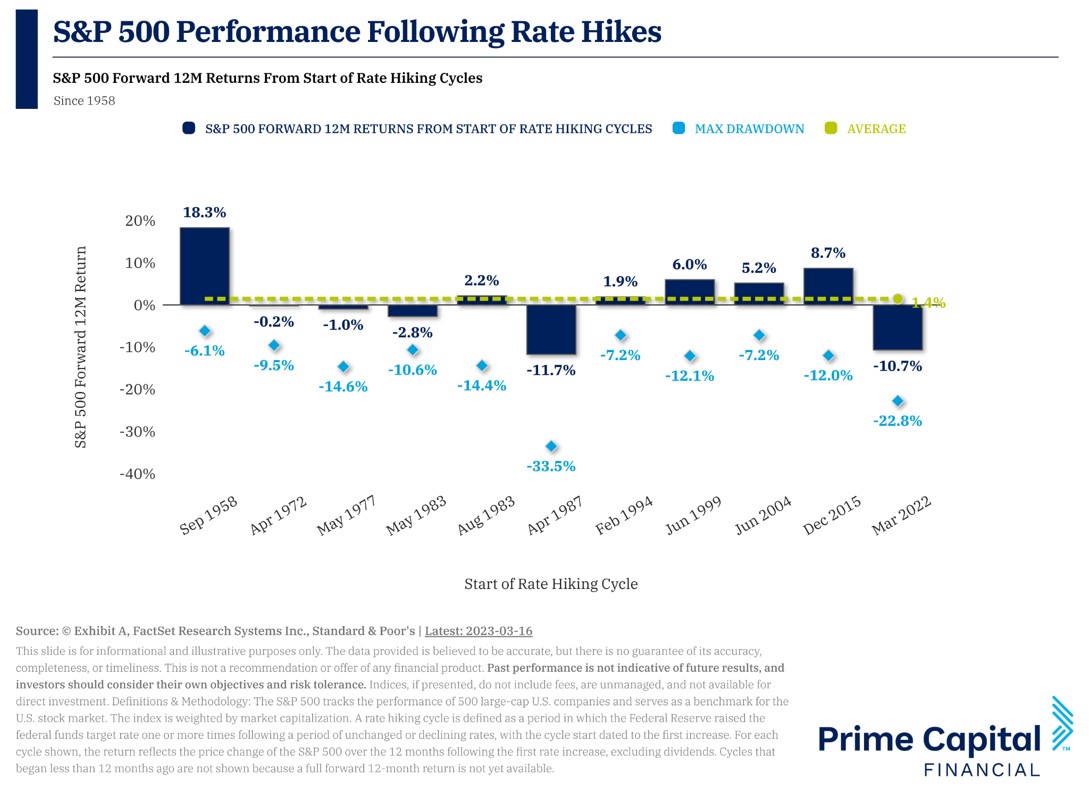
If rates stay elevated longer than investors expected, some areas of the market are likely to feel more pressure than others. Clayton Allison, Portfolio Manager at Prime Capital Financial, said the most vulnerable companies are often the ones that rely heavily on debt financing.
That starts with small-cap stocks. Many smaller companies are still unprofitable, which means they frequently depend on borrowing to fund growth. When borrowing costs rise, the math gets harder. Debt that looked manageable in a low-rate environment can become much more expensive to refinance.
The same challenge can affect higher-growth companies with leveraged balance sheets. A lot of businesses took advantage of the ultra-low-rate environment in 2020 and 2021. That cheap money helped fuel expansion, but now some of that debt is coming due at much higher rates. If a company has to refinance at today’s levels, profitability can take a hit.
This is where investors can get tripped up. Rate hikes do not hit all stocks equally. They tend to put the most pressure on businesses that need easy access to capital or that have not yet built enough cash flow to absorb higher financing costs.
In practical terms, that means you should be more cautious about assuming all parts of the equity market will respond the same way. A higher-rate world often rewards stronger balance sheets and punishes companies that are still dependent on cheap borrowing.
What to Watch in Equities
- Small caps: Often more sensitive to borrowing costs and refinancing risk.
- Unprofitable growth companies: Higher rates can compress valuation and raise financing costs.
- Highly leveraged businesses: More exposed when debt needs to be renewed at current market rates.
Why Fixed Income Looks More Attractive Now
While higher rates can create headwinds for certain stocks, they can also create opportunities elsewhere. Allison made the case that fixed income is becoming much more attractive, especially for income-focused investors.
For years, bond investors had to deal with very low yields. That meant fixed income often played a smaller role in portfolios because the income simply was not compelling enough. But now, with yields climbing above 5% in some areas, the picture has changed.
That matters for retirees in particular. If you rely on portfolio income, higher yields can provide real cash flow without forcing you to take on as much equity risk. In other words, bonds are not just back. They may actually be useful again as an income source.
Allison also noted that long-duration fixed income can become more compelling in this environment. For investors who want to lock in higher yields, today’s rates may offer a more attractive entry point than we’ve seen in years.
This does not mean bonds are risk-free. Duration still matters, and bond prices can still move lower if rates rise further. But in a portfolio-construction sense, higher yields make fixed income a much more interesting tool than it was when rates were near zero.
For investors who have spent years chasing equity returns because bonds offered so little, this may be a good time to revisit the role of income in your plan.
What Data Will Matter Before the Next Fed Meeting?
The next Fed move will depend heavily on the data. McGough emphasized that the central bank is likely watching whether inflation continues to hover just above the line or starts moving convincingly lower.
One key variable is oil prices. If energy costs ease, that can help cool inflation and reduce pressure on the Fed. But there is also another possibility worth considering: stronger real growth.
That may sound surprising, because many investors think of inflation as purely negative. But if GDP grows faster while inflation comes down, that creates a healthier backdrop for the economy. McGough noted that nominal growth has been decent, but what really matters is whether growth turns more productive—meaning prices rise less while real output improves.
That distinction is important. Not all inflation is the same. Inflation driven by strong demand and improving growth is different from inflation caused by supply strain or energy shocks. The Fed will be trying to tell the difference, and investors should as well.
For investors, the takeaway is simple: do not react to one headline. The Fed is going to respond to a sequence of data points, not a single number. That means inflation readings, oil prices, GDP trends, and labor market data all deserve attention.
The Indicators Worth Watching
- CPI and monthly inflation trends
A few tenths of a point can change the Fed’s tone quickly. - Oil and energy prices
These can either reinforce inflation pressure or help relieve it. - GDP and real growth data
Strong growth with cooling inflation is a much better setup than stagnation with high prices. - Labor market strength
If jobs remain solid, the Fed may feel less urgency to cut rates soon.
What This Means for Your Financial Plan
This is where the conversation shifts from markets to your life.
An important point to keep in mind is that interest rates, inflation, and Fed policy do not exist in a vacuum. They interact with your goals, your time horizon, and the structure of your financial plan. That means the same rate hike can affect two investors in completely different ways.
If you are saving for retirement, higher rates may help your cash reserves earn more. If you are already retired and living on portfolio income, stronger bond yields may be welcome. But if you own a portfolio concentrated in rate-sensitive, debt-heavy companies, the impact may be less favorable.
The wrong response is to panic and make a major allocation change based on one meeting. The better response is to ask whether your portfolio is built for a higher-rate environment.That can mean:
- Reviewing your exposure to small caps and highly leveraged companies
- Reassessing the role of bonds and cash in your plan
- Checking whether your expected income still matches your spending needs
- Making sure your time horizon is still aligned with your risk level
A financial advisor can help you pressure-test those assumptions before the next surprise hits. That is especially helpful when policy is changing and markets are adjusting at the same time.
RESOURCE: Generating Portfolio Income in a Rising Rate Environment
Frequently Asked Questions
- Why did the Fed raise rates when the economy is still strong?
Because inflation is still above the Fed’s comfort zone. Even with solid spending and a healthy labor market, policymakers may decide it is better to keep pressure on inflation than to wait too long and risk it staying elevated. - Which investments are most sensitive to higher interest rates?
Small-cap stocks, unprofitable growth companies, and highly leveraged businesses are often the most vulnerable. Their borrowing costs can rise quickly when rates stay higher for longer. - Are bonds finally attractive again?
In many cases, yes. Higher yields have made fixed income much more appealing, especially for income-focused investors and retirees who want more predictable cash flow. - What should investors watch next?
The biggest signals will likely be inflation data, oil prices, GDP growth, and labor-market trends. Those indicators will help show whether the Fed sees more reason to hike again or pause.
Let’s Chat!
If you have questions about this topic, or any others, and would like to speak to a financial advisor, fill out the form below and a member from our team will reach out to you shortly.
Advisory products and services offered by Investment Adviser Representatives through Prime Capital Investment Advisors, LLC (“PCIA”), a federally registered investment adviser. Tax planning and preparation services are offered through Prime Capital Tax Advisory. PCIA: 6201 College Blvd., Suite 150, Overland Park, KS 66211. PCIA doing business as Prime Capital Financial | Wealth | Retirement | Wellness | Family Office | Tax Advisory.