

As families prepare for another school year, many states are offering temporary sales tax holidays that can help reduce the cost of clothing, school supplies, backpacks, and even computers. According to the NRF’s most recent back-to-school survey, families with children in elementary through high school plan to spend an average of $858.07 on clothing, shoes, supplies, and electronics, with total back-to-school spending expected to reach $39.4 billion nationally. Against that backdrop, understanding your state’s sales tax holiday rules can make a real difference, especially for larger families shopping for multiple children.
Key Takeaways About Back-to-School Sales Tax Holidays
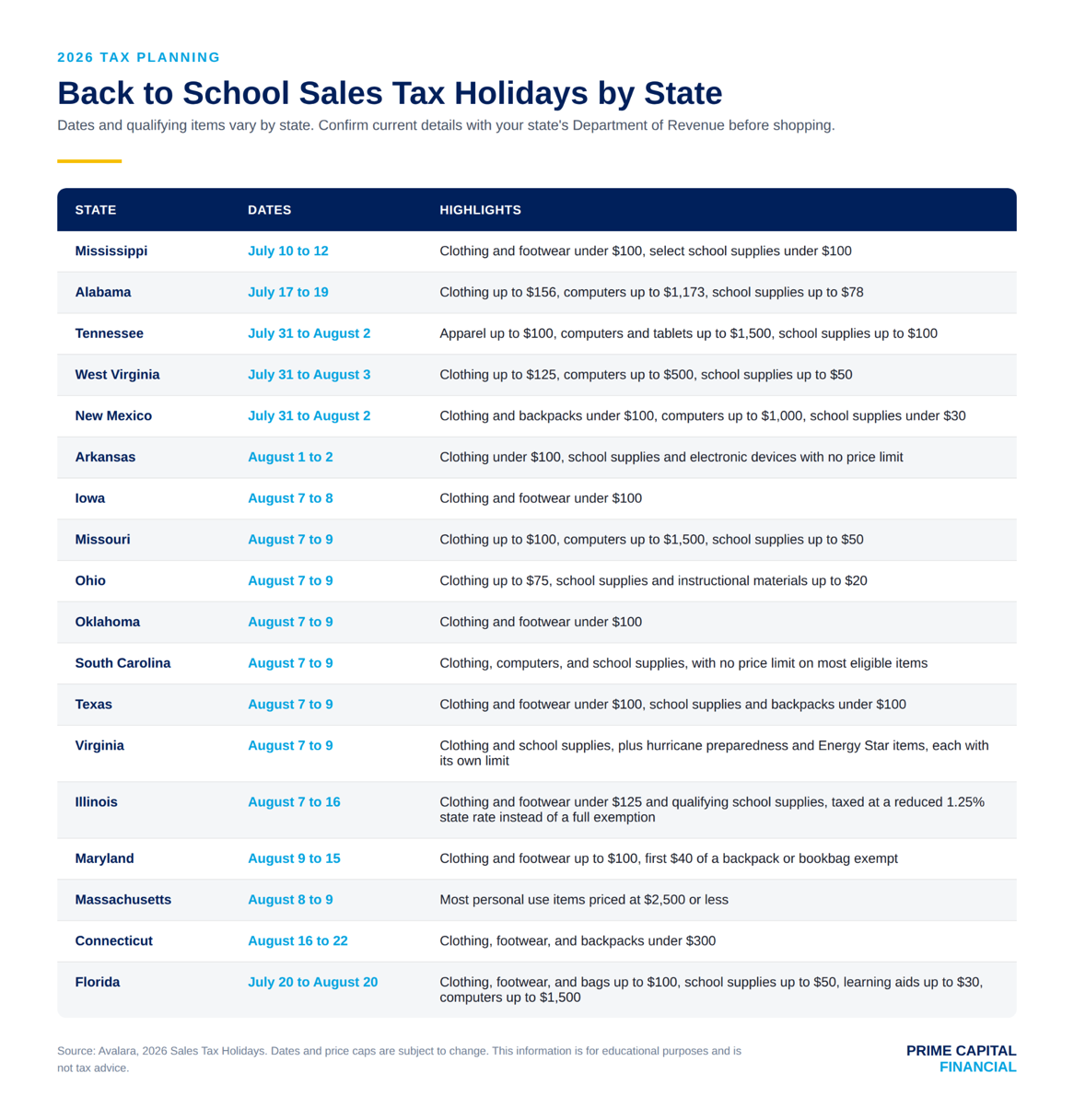
- Eighteen states are holding a back-to-school sales tax holiday in 2026, typically in July or August.
- Qualifying items and price limits vary widely by state, so it pays to check the rules where you live.
- Kansas and Colorado, home to two Prime Capital Financial offices, are among the states that do not offer a sales tax holiday.
- Combining a tax-free weekend with a broader savings strategy, like a 529 plan, can help stretch a family’s education budget further.
What Is a Sales Tax Holiday?
A sales tax holiday is a set period during which a state temporarily suspends sales tax on certain items. Most back-to-school holidays are scheduled in July or August. However, some states also hold separate tax-free periods for emergency supplies, energy-efficient appliances, or other categories at other points in the year.
While roughly half of U.S. states offer a back-to-school sales tax holiday, others, including Kansas and Colorado, where Prime Capital Financial has offices, do not. The specifics that participating states do offer, including dates, qualifying items, and price caps, are set individually, so what applies in one place may look very different in a few states over.
2026 Back-to-School Sales Tax Holidays by State
Price limits generally apply per item, and rules on what counts as qualifying clothing, school supplies, or electronics can vary. It is worth reviewing your state’s official Department of Revenue guidance before shopping.
States Without a Back-to-School Sales Tax Holiday
States without a back-to-school sales tax holiday include Kansas, Colorado, California, Indiana, New York, and Washington, among others. Residents in these states generally pay the normal sales tax rate on school-related purchases year-round. Oregon is a separate case: it has no state sales tax at all, so a holiday does not apply there.
What Typically Qualifies
While rules differ state by state, most sales tax holidays are built around a few common categories:
- Clothing and footwear, usually under a per-item price cap
- School supplies, such as notebooks, pens, and backpacks
- Computers and related technology, often with a higher price threshold
- In some states, additional categories like bed and bath items or instructional materials
Items used for a trade or business, layaway purchases, and accessories like jewelry are commonly excluded, even in states with generous exemptions. It is worth checking your state’s Department of Revenue site for the full list before you shop.
How to Prepare
A little planning goes a long way during a sales tax holiday.
Make a list ahead of time so purchases stay focused on qualifying items. Check your specific state’s price limits, since an item priced just over the cap may not qualify at all. Confirm whether online orders count. In most states, an order qualifies if it is placed and paid for during the holiday window, even if delivery happens later. Compare retailer discounts with the tax savings. A store offering 25 percent off may provide greater savings than waiting for a tax-free weekend. Remember that local tax rules can differ from state tax rules, so the exemption may not always cover the full amount you would otherwise pay at checkout.
How This Fits Into a Bigger Picture
Saving a few dollars during a tax-free weekend will not pay for college, but it reflects the same mindset that supports long-term financial success. Looking for opportunities to reduce everyday expenses while consistently saving for future education costs can help families build stronger financial habits over time. Tools like 529 college savings plans or Coverdell accounts work well alongside these everyday savings opportunities, giving families more flexibility as education costs come due each year.
If you would like to talk through how back-to-school savings and long-term education planning fit together for your family, a Prime Capital Financial advisor is happy to help you think it through.
Frequently Asked Questions About Sales Tax Holidays
- What is a sales tax holiday? A sales tax holiday is a temporary period, usually a few days, during which a state suspends sales tax on qualifying purchases, such as clothing, school supplies, or computers.
- Do all states offer a sales tax holiday? No. Each state’s legislature decides participation, and the list of states, along with the dates and qualifying items, can change from year to year.
- Do online purchases qualify? In most states, yes, as long as the order is placed and paid for during the holiday window. Some states also allow qualifying items to ship after the holiday ends if payment was completed on time.
- Is there a price limit on qualifying items? Most states set a price cap per item, typically around $100 for clothing and higher for computers, though a few states, such as South Carolina, do not cap most eligible purchases.
- Does my state’s sales tax holiday cover local tax, too? It depends on the state. Some sales tax holidays apply to both state and local tax, while others, like Maryland’s and Massachusetts’s, apply to state tax only since those states do not have a separate local sales tax.
Sources
National Retail Federation and Prosper Insights & Analytics, 2026 back-to-school spending survey
Avalara, 2026 Sales Tax Holidays
Texas Comptroller of Public Accounts
South Carolina Department of Revenue
Massachusetts Department of Revenue
Individual state Departments of Revenue for all states listed in the table above
Let’s Chat!
If you have questions about this topic, or any others, and would like to speak to a financial advisor, fill out the form below and a member from our team will reach out to you shortly.
This information does not constitute legal advice. Prime Capital Financial and its associates do not provide legal advice. Individuals should consult with an attorney regarding the applicability of this information for their situations.
Advisory products and services offered by Investment Adviser Representatives through Prime Capital Investment Advisors, LLC (“PCIA”), a federally registered investment adviser. Tax planning and preparation services are offered through Prime Capital Tax Advisory. PCIA: 6201 College Blvd., Suite 150, Overland Park, KS 66211. PCIA doing business as Prime Capital Financial | Wealth | Retirement | Wellness | Family Office | Tax Advisory.