

Individuals who are newly retired, or who have traditionally deferred to a spouse for household finances, may not realize they have a valuable tool for creating consistent cash flow while also opening the door to thoughtful charitable giving. Required minimum distributions, or RMDs, can help retirees enjoy the fruits of their younger selves’ labor while making strategic decisions about how those retirement savings fit into their lives today.
RMDs also come with firm deadlines, making it important for retirees to understand how they work and avoid unnecessary tax penalties. As year-end approaches, those subject to RMDs should confirm how much they must withdraw, when the distribution is due, and how that income fits into their broader financial plan. For many retirees, October is an ideal time to review those decisions before the December 31 deadline gets too close.
Key Takeaways
- Retirees generally must begin required minimum distributions in the year they reach age 73, or age 75 for those born in 1960 or later.
- The first RMD may generally be delayed until April 1 of the following year. Delaying means two RMDs are due in that same year.
- Every RMD after the first is generally due by December 31 each year.
- Missing an RMD deadline can result in a penalty of up to 25% of the amount not withdrawn, which may be reduced to 10% if corrected within two years.
Why RMD Planning Matters
RMD rules generally require retirees to begin drawing down tax-deferred retirement assets once they reach the applicable age. The timing does not happen in isolation, since additional taxable income from an RMD can affect an individual’s tax bracket, Medicare income-related surcharges, and the taxation of Social Security benefits. Planning ahead can help retirees approach the year-end deadline with a clear plan.
For retirees with flexibility around other income or charitable giving, reviewing RMDs before taking a distribution may uncover additional planning opportunities.
When RMDs Begin
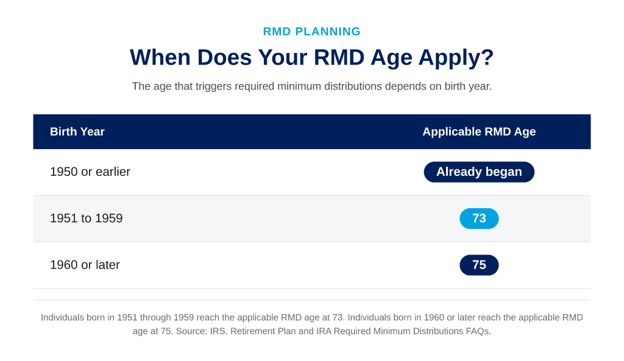
RMDs generally start in the year an IRA owner reaches age 73, or age 75 for those born in 1960 or later. Traditional IRAs, SEP IRAs, and SIMPLE IRAs are generally subject to these rules.
Workplace retirement plans, such as 401(k)s, may allow participants to delay RMDs until retirement, depending on the plan. Different rules can apply to certain business owners, and Roth IRAs and designated Roth accounts in workplace plans are generally not subject to RMDs during the original owner’s lifetime.
The Two Key Deadlines to Know
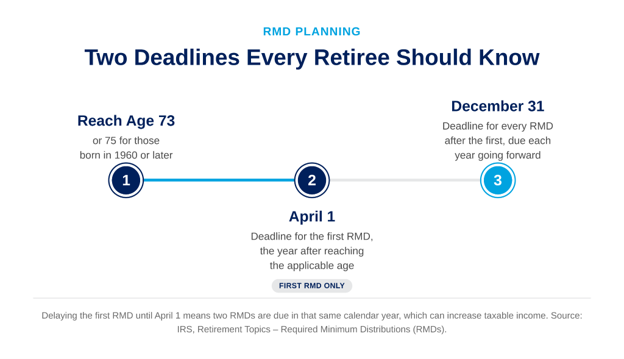
The first RMD may be taken any time during the year a retiree reaches the applicable RMD age, or delayed until April 1 of the following year.
Choosing to delay means two RMDs are due that following year:
- One by April 1
- One by December 31
It’s important to recognize that taking two RMDs in the same year can increase taxable income for that year. After that, the recipient drops into a regular cadence, with every RMD after the first following a single deadline of December 31 each year.
How RMDs Are Calculated
An RMD is generally calculated by dividing the retirement account balance as of December 31 of the prior year by an applicable life expectancy factor published by the IRS. The specific table used can depend on the account owner’s circumstances.
Retirees with multiple retirement accounts generally need to calculate the RMD for each account separately. In some cases, IRA owners may be able to take the total required IRA distribution from one or more of their IRAs.
Five Ways to Approach RMD Planning
- Start early
Reviewing account balances and calculating the RMD amount well before the deadline allows time to plan the withdrawal thoughtfully. A financial advisor can help to ensure this process is part of a larger financial plan.
- Consider whether a Roth conversion fits the broader plan
Converting a portion of tax-deferred retirement assets to a Roth IRA before RMDs begin may reduce future RMDs. Because the converted amount is generally taxable in the year of conversion, the timing and amount should be evaluated alongside other income, tax brackets, and financial planning considerations.
- Explore a qualified charitable distribution
Eligible IRA owners age 70½ and older may make qualified charitable distributions directly to eligible charities. For 2026, the annual QCD exclusion limit is $111,000, and qualifying distributions can count toward an RMD.
- Set up tax withholding
Withholding taxes directly from the distribution can help retirees avoid a larger bill at tax time.
- Coordinate with the full financial picture
We cannot emphasize the value of a financial plan enough. RMDs work best as part of a broader strategy that accounts for other income sources, tax brackets, and long-term goals.
A Timely Reminder as Year-End Approaches
For retirees who reached the applicable RMD age this year, October is a good moment to decide whether to take the first distribution now or wait until April 1. Those who have been taking RMDs for a while can use this time to confirm the withdrawal is complete or scheduled.
Waiting until the final weeks of the year can add unnecessary pressure, especially for retirees managing withdrawals across several accounts. A short review now can help make the final months of the year easier to manage.
If you would like help calculating your RMD or fitting it into your broader financial plan, connect with a Prime Capital Financial advisor.
Frequently Asked Questions About RMDs
At what age do RMDs start?
RMDs generally begin the year a retiree reaches age 73, or age 75 for those born in 1960 or later.
What happens if I miss an RMD deadline?
The IRS may assess a penalty of up to 25% of the amount not withdrawn. This penalty may be reduced to 10% if the mistake is corrected within two years, and the IRS may waive the penalty in certain circumstances.
Can I delay my first RMD?
Yes. The first RMD may generally be delayed until April 1 of the year after reaching the applicable age. This means two RMDs will be due that same year, which can increase taxable income.
How is my RMD amount calculated?
The prior year-end account balance is generally divided by an applicable life expectancy factor published by the IRS. The specific table used can depend on the account owner’s circumstances.
Can a qualified charitable distribution help with my RMD?
Yes. Eligible IRA owners age 70½ and older may direct qualifying distributions to eligible charities, and those distributions can count toward satisfying the RMD.
Sources
IRS, Retirement Plan and IRA Required Minimum Distributions FAQs
IRS, Retirement Topics – Required Minimum Distributions (RMDs)
Let’s Chat!
If you have questions about this topic, or any others, and would like to speak to a financial advisor, fill out the form below and a member from our team will reach out to you shortly.
This information does not constitute tax or legal advice. Prime Capital Financial and its associates do not provide tax or legal advice. Individuals should consult with a qualified tax professional or attorney regarding the applicability of this information to their individual situation.
Advisory products and services offered by Investment Adviser Representatives through Prime Capital Investment Advisors, LLC (“PCIA”), a federally registered investment adviser. PCIA: 6201 College Blvd., Suite 150, Overland Park, KS 66211. PCIA doing business as Prime Financial | Wealth | Retirement | Wellness | Family Office | Tax Advisory | Endowments & Foundations. Tax planning and preparation services are offered through Prime Financial Tax Advisory.