

Key Takeaways
- Tax planning is most useful when your tax professional knows about important financial and life changes as they happen.
- A new job, marriage, divorce, growing family, business venture, investment gain, home sale, or shift to self-employment can change your tax picture during the year.
- Withholding and estimated tax payments may need to be adjusted as income and circumstances change.
- Some tax-planning decisions are tied to the calendar year or must be made before a transaction occurs, which can limit your options if you wait until tax filing season.
- A midyear or year-end conversation can help identify planning opportunities and prepare for potential tax obligations before your return is due.
For many people, talking to a tax professional is an annual event.
Documents arrive in January. A meeting gets scheduled sometime before April 15. The return gets prepared, the numbers are reviewed, and taxes are filed.
Then another year passes before the next conversation.
That schedule may work for preparing a tax return. But let’s be real. Your financial life rarely follows the tax filing calendar.
Income changes. People change jobs. Families grow. Businesses start. Investments are sold. Homes change hands. Retirement decisions are made. Each of those events can affect the taxes you ultimately owe and the planning opportunities available to you.
Keeping your tax professional informed throughout the year can help you better plan before important decisions are already made (and key opportunities are missed).
Tax Preparation Is Only Part of the Picture
By the time your tax professional prepares your return, most of the financial activity being reported has already happened.
Your return documents income you earned, deductions you qualified for, investments you sold, business activity you completed, and other financial events from the prior tax year.
The planning part of your tax preparation can actually begin much earlier.
Keeping your tax professional informed during the year allows them to evaluate how a change may affect your tax situation and whether there are actions worth considering while you still have time to make them.
The IRS’s Tax Withholding Estimator specifically identifies situations such as marriage, divorce, the birth or adoption of a child, multiple jobs, investment income, freelance income, and other income without automatic withholding as reasons someone may want to revisit how much tax is being withheld. Reviewing withholding when financial or personal circumstances change is something the agency actively encourages.
That makes tax planning an ongoing part of managing your financial life.
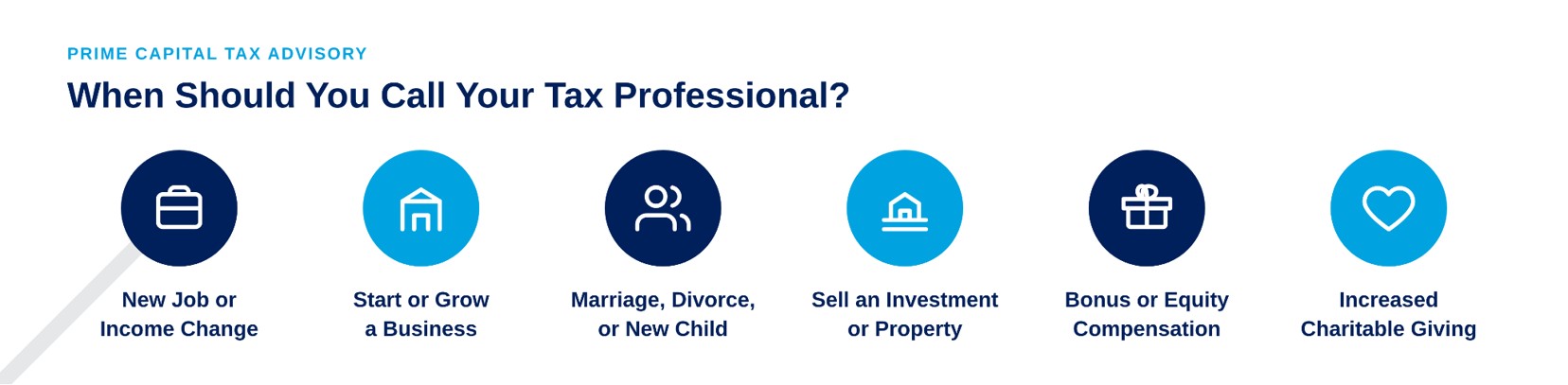
You do not necessarily need a formal tax meeting every few months. A meaningful change in your financial situation can be a good reason to check in.
You Change Jobs or Your Income Changes
A new salary, bonus structure, second job, large commission, or other income change can affect how much tax should be withheld from your paycheck.
Changes within your household matter too. If both spouses work, one spouse stops working, or either person’s income changes significantly, the amount being withheld may no longer align with the household’s expected tax liability.
Employees can adjust federal income tax withholding at any time by submitting an updated Form W-4 to their employer.
A tax professional can help you look at the change in the context of your full financial picture.
You Move From W-2 Employment to Self-Employment
Becoming an independent contractor can change much more than where your paycheck comes from.
Self-employed individuals are generally responsible for self-employment tax, which covers Social Security and Medicare taxes. The federal self-employment tax rate is 15.3%, subject to the applicable rules and wage limits. Self-employed individuals may also need to make estimated tax payments during the year because taxes are generally no longer being withheld automatically from each paycheck.
The transition can also introduce questions about estimated taxes, business deductions, retirement planning, and how the business should be structured. Those are conversations worth having when the transition occurs rather than waiting until the following tax season.
You Get Married, Divorced, or Have a Child
Changes within your household can affect filing status, withholding, tax credits, deductions, and other areas of your return.
The IRS specifically recommends that newly married couples review their withholding, since marriage can affect tax brackets and other tax calculations, particularly when both spouses work.
A new child or adoption can also introduce tax considerations that should be incorporated into your planning during the year.
You Start or Grow a Business
Starting a business introduces a series of tax decisions.
How will the business be structured? How will you pay yourself? Will you have employees? Do you need to make estimated payments? What expenses should you track? What type of retirement plan might be available?
As revenue grows, some of those answers may change.
Checking in with your tax professional as the business develops allows you to evaluate those questions using current information.
You Sell an Investment, Property, or Business
A significant sale can create a taxable gain and meaningfully change your expected income for the year.
If you are considering selling appreciated investments, real estate, a business interest, or another major asset, involving your tax professional before the transaction can help you understand the potential tax consequences and incorporate them into the broader decision.
The timing, type of asset, holding period, other gains and losses, and your overall income can all affect the result.
You Receive a Large Bonus, Equity Compensation, or Other Unexpected Income
A major increase in income may affect your withholding, estimated payments, deductions, credits, investment decisions, and other areas of your tax picture.
Stock options and other forms of equity compensation can add another layer, since different types of awards can carry different tax treatment and timing considerations.
A tax conversation before exercising options, selling shares, or making another major transaction can help you understand what the decision may mean for your overall tax situation.
Your Charitable Giving Increases
Charitable giving can involve more planning than writing a check at the end of the year.
The tax treatment may depend on the type of asset donated, the organization receiving it, whether you itemize deductions, your income, and other factors. Beginning with tax year 2026, federal law also allows eligible taxpayers who do not itemize to deduct up to $1,000 of qualifying cash charitable contributions, or up to $2,000 for married couples filing jointly.
If philanthropy is an important part of your financial plan, discussing your goals earlier in the year may help coordinate charitable, investment, and tax decisions.
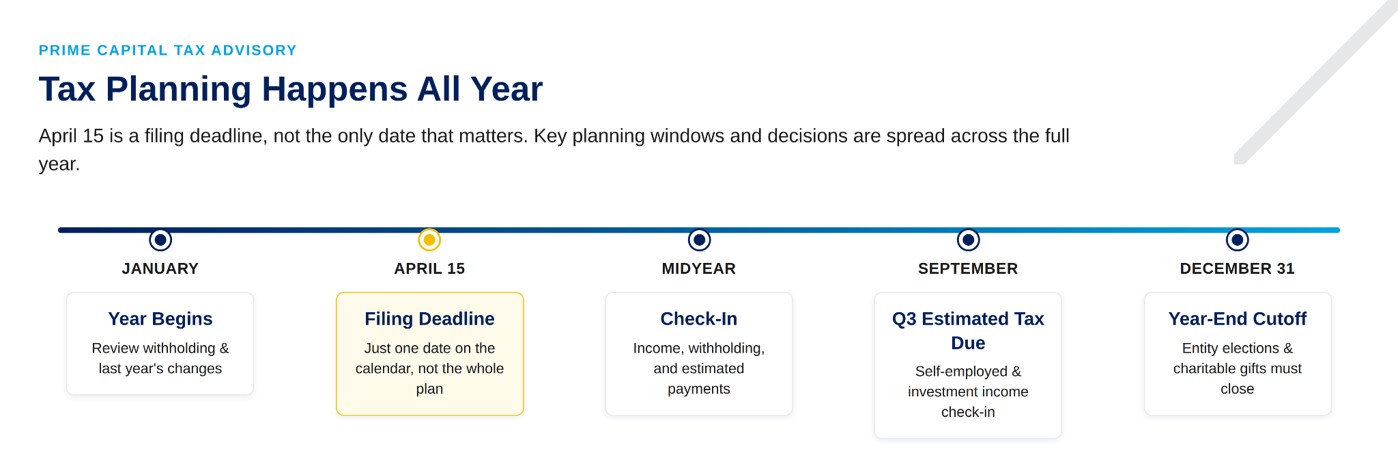
Tax planning has deadlines.
Some planning deadlines fall after December 31, while many decisions need to be made before the tax year ends.
For example, traditional and Roth IRA contributions generally can be made until the tax return filing deadline, excluding extensions. For 2026, the annual IRA contribution limit is $7,500, with an additional $1,100 catch-up contribution available to eligible individuals age 50 and older.
Other planning decisions may need to happen much sooner. Involving your tax professional before year-end and before major financial transactions gives them the chance to identify which deadlines apply to your situation and where there may still be time to act.
Consider a Midyear Tax Check-In
You do not need to wait for a major event to talk with your tax professional.
A midyear review can be useful for taking stock of what has happened since your last return and what you expect during the remainder of the year.
That conversation might include:
- Changes in income or withholding
- New sources of investment, freelance, rental, or business income
- Estimated tax payments
- Business income and expenses
- Investment gains or losses
- Retirement contributions
- Charitable giving
- Upcoming property or business transactions
- Significant family or employment changes
- Financial decisions planned before year-end
If your income is not subject to automatic withholding, estimated taxes can be especially important. Self-employed individuals generally use estimated tax payments to pay income tax and self-employment tax during the year.
Reviewing those numbers before filing season can help you plan for the amount you may owe.
Your Tax Professional Needs to Know When Your Financial Life Changes
Your tax professional can only plan around the information they have. When something meaningful changes in your financial life, bringing them into the conversation early can help identify potential tax implications and planning opportunities while there is still time to act.
You do not need to know whether an event has tax consequences before you call. A job change, new business, marriage, investment sale, unexpected income, or other significant financial decision can all be reasons to check in.
April 15 may be the date most associated with taxes. Effective tax planning happens throughout the year.
If something has changed in your financial life this year, consider talking with your tax professional now about what it could mean for your tax plan.
Sources
Let’s Chat!
If you have questions about this topic, or any others, and would like to speak to a financial advisor, fill out the form below and a member from our team will reach out to you shortly.
Advisory products and services offered by Investment Adviser Representatives through Prime Capital Investment Advisors, LLC (“PCIA”), a federally registered investment adviser. PCIA: 6201 College Blvd., Suite 150, Overland Park, KS 66211. PCIA doing business as Prime Financial | Wealth | Retirement | Wellness | Family Office | Tax Advisory | Endowments & Foundations. Tax planning and preparation services are offered through Prime Financial Tax Advisory.