

Key Takeaways
- Moving from W-2 employment to independent contractor work changes how taxes are paid and what financial responsibilities fall on you.
- Independent contractors generally need to plan for income tax and self-employment tax because taxes are no longer automatically withheld from each paycheck.
- Estimated tax payments, business expenses, recordkeeping, insurance, retirement planning, and business structure can all become part of the picture.
- The same dollar amount may not provide the same economic value as contractor income once taxes and employer-provided benefits are considered.
- Talking with a tax professional early can help you understand your new obligations and identify planning opportunities before tax filing season.
A company offers you the same role, the same responsibilities, and the same $100,000 you were earning as an employee. There is just one change: instead of receiving a W-2, you will now work as an independent contractor.
At first glance, the offer may look almost identical. Financially, it is a very different arrangement.
When you move from W-2 employment to independent contractor work, taxes are generally no longer withheld from every paycheck. You may become responsible for self-employment tax, estimated tax payments, your own benefits, business expenses, and decisions you previously never had to make.
Understanding those changes early can make the transition much easier to manage.
First, Understand What 1099 Work Actually Means
A Form 1099 may be used to report payments made to an independent contractor, but receiving a 1099 does not simply mean your employer changed the tax form attached to your job.
Independent contractors are generally considered self-employed for federal tax purposes. The IRS looks at factors including behavioral control, financial control, and the nature of the relationship between the worker and the business when determining whether someone is properly classified as an employee or independent contractor.
That distinction matters because employees and independent contractors have different tax responsibilities. If you are legitimately moving into independent contractor work, several parts of your financial life may need to change.
1. Taxes Are No Longer Automatically Coming Out of Your Pay
As a W-2 employee, federal income tax, Social Security tax, and Medicare tax are generally withheld from your paycheck. Your employer also pays its share of Social Security and Medicare taxes.
As an independent contractor, that system changes.
Self-employed individuals generally pay self-employment tax, which covers Social Security and Medicare. The federal self-employment tax rate is 15.3%, consisting of 12.4% for Social Security and 2.9% for Medicare, subject to applicable income limits and rules.
You may also owe federal income tax on your business income. Because there is usually no employer withholding those taxes for you, it becomes your responsibility to plan for them.
2. You May Need to Make Estimated Tax Payments
The federal income tax system is pay-as-you-go.
For many employees, withholding handles that automatically.
Independent contractors may need to make estimated tax payments during the year to cover income tax, self-employment tax, and potentially other taxes.
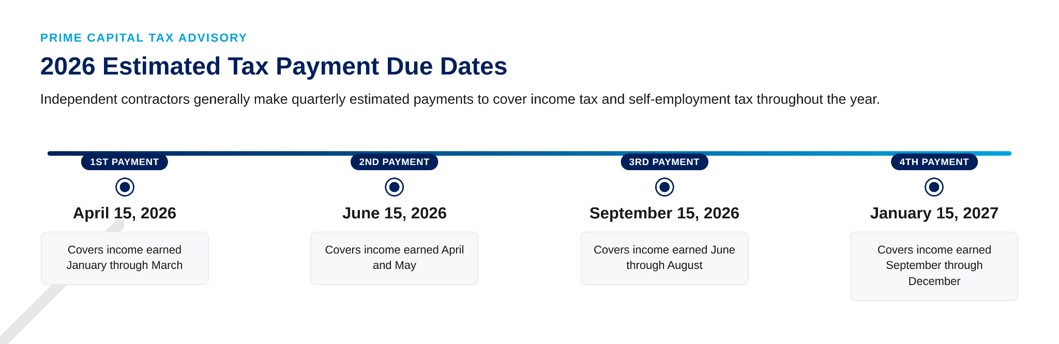
For the 2026 tax year, the standard federal estimated tax payment dates are:
- April 15, 2026
- June 15, 2026
- September 15, 2026
- January 15, 2027
The amount you need to pay depends on your income, deductions, other household income, withholding from other sources, and overall tax situation. Waiting until you prepare your return to think about taxes can create an unpleasant cash-flow surprise. A tax professional can help estimate what you may owe and determine an appropriate payment schedule.
3. Do Not Assume the Same Salary Equals the Same Compensation
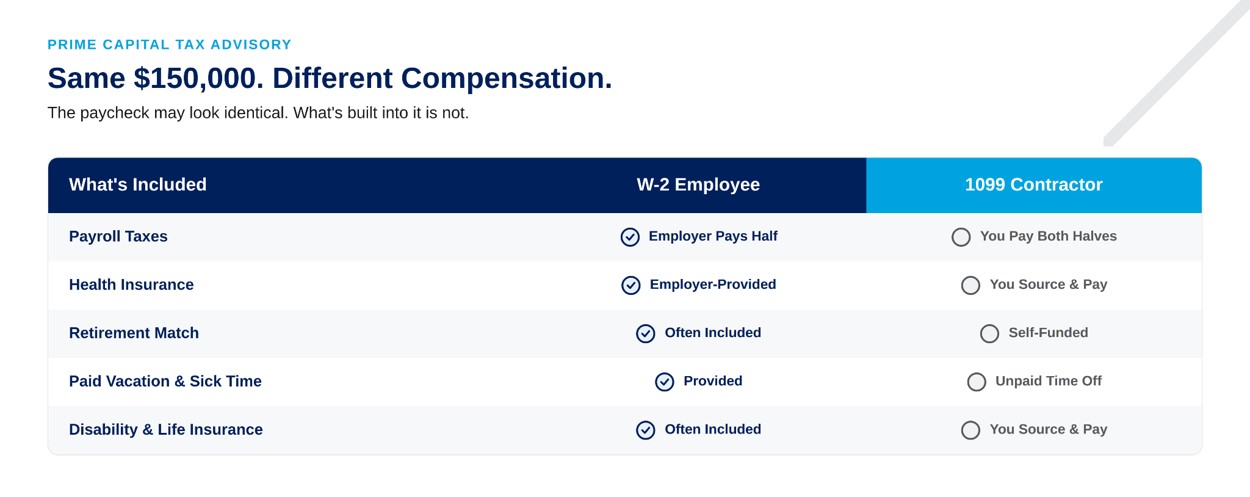
One of the easiest mistakes to make when moving from W-2 to 1099 work is comparing the numbers dollar-for-dollar.
Suppose you earned $150,000 as an employee and are offered $150,000 as a contractor. Those two arrangements may have very different economic value.
As an employee, your compensation may have included:
- Employer-paid payroll taxes
- Health insurance
- Retirement plan contributions or matching
- Paid vacation and sick time
- Disability or life insurance
- Other employee benefits
As a contractor, some or all of those costs may shift to you. Contractor compensation is often worth evaluating as a complete financial package rather than simply comparing gross income.
4. Start Treating Your Work Like a Business
When you become self-employed, good financial organization becomes much more important.
You may need a system for tracking:
- Business income
- Business expenses
- Invoices and payments
- Receipts
- Mileage or business travel
- Equipment and technology purchases
- Professional services
- Insurance
- Estimated tax payments
Self-employed individuals generally report business income and expenses on Schedule C when operating as a sole proprietor. Keeping accurate records throughout the year can make tax preparation easier and help ensure you are properly documenting deductible business expenses.
5. Learn Which Business Expenses May Be Deductible
Independent contractors may be able to deduct ordinary and necessary expenses associated with operating their business.
Depending on the type of work you do, those expenses could include items such as:
- Software and technology
- Professional licenses or subscriptions
- Business insurance
- Advertising and marketing
- Professional services
- Certain travel expenses
- Office supplies and equipment
- Eligible home office expenses
The rules vary depending on the expense and how it is used. The important habit is to start tracking business expenses as soon as you become self-employed rather than trying to reconstruct them at the end of the year.
6. Understand the Qualified Business Income Deduction
Some self-employed taxpayers may qualify for the qualified business income deduction, commonly called the QBI or Section 199A deduction. Eligible taxpayers may generally deduct up to 20% of qualified business income, although income thresholds, the type of business, wages, property, and other factors can affect how the deduction is calculated.
The deduction is available to qualifying owners of sole proprietorships, partnerships, S corporations, and certain other pass-through businesses. It is one reason your business structure and overall taxable income can matter.
7. Revisit Your Retirement Plan
Leaving W-2 employment may also mean leaving an employer-sponsored retirement plan behind.
Self-employment creates several retirement-planning options of its own. Depending on your circumstances, those may include a SEP IRA, SIMPLE IRA, or one-participant 401(k), often called a solo 401(k).
A solo 401(k), for example, can allow an eligible self-employed person to contribute in two capacities: as the employee and as the employer. For 2026, the general employee elective deferral limit for a 401(k) is $24,500. Employer contributions may also be permitted, subject to plan rules and overall contribution limits.
The right plan depends on factors including your income, business structure, employees, age, and savings goals. This is one area where planning earlier in the year can be especially valuable.
8. Consider Whether Your Business Structure Still Makes Sense
Many independent contractors begin as sole proprietors because it is simple. As income grows, it may be worth discussing whether another structure is appropriate.
For some taxpayers, an S corporation election may provide planning opportunities because an owner who works in the business can receive reasonable W-2 compensation while eligible remaining business profit may be distributed without being subject to self-employment tax.
An S corporation also brings additional responsibilities, including payroll, a separate business tax return, bookkeeping, administrative costs, and reasonable compensation requirements.
There is no universal income level at which an S corporation automatically becomes the right choice. The decision should be modeled using your specific income, expenses, state tax rules, retirement goals, and other circumstances.
9. Replace the Benefits You Used to Receive Through Work
Taxes are only one part of becoming self-employed. You may also need to make decisions about benefits that your former employer previously handled.
That could include:
- Health insurance
- Disability insurance
- Life insurance
- Retirement savings
- Paid time off
- Emergency savings
- Business liability coverage
These costs can affect how much you actually keep from your contractor income and how much you should charge for your work.
Planning for them early can make your transition more financially sustainable.
10. Talk to Your Tax Professional Before Filing Season
The move from W-2 employment to independent contractor work is exactly the kind of change that should prompt a tax-planning conversation. You may need to address estimated payments, business deductions, retirement contributions, insurance, bookkeeping, and entity structure long before your next tax return is due.
A tax professional can help you determine which of those issues apply to you and how they fit together.
The goal is not simply to prepare for a different tax form next April. It is to build a financial and tax structure that works for the way you earn income now.
Your First 1099 Checklist
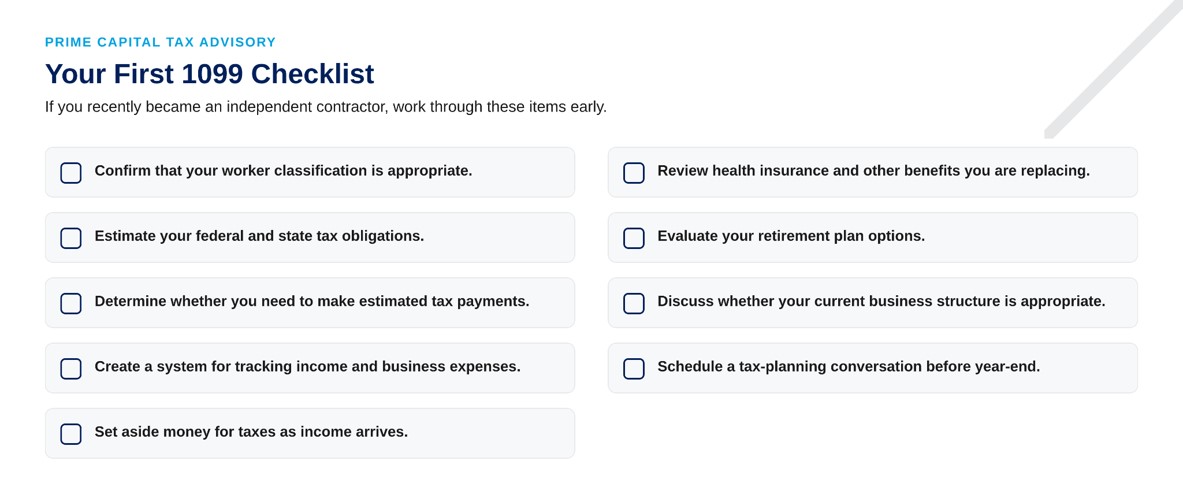
If you recently became an independent contractor, consider working through these items early:
- Confirm that your worker classification is appropriate.
- Estimate your federal and state tax obligations.
- Determine whether you need to make estimated tax payments.
- Create a system for tracking income and business expenses.
- Set aside money for taxes as income arrives.
- Review health insurance and other benefits you are replacing.
- Evaluate your retirement plan options.
- Discuss whether your current business structure is appropriate.
- Schedule a tax-planning conversation before year-end.
Becoming an independent contractor can create more responsibility, along with new planning opportunities. Taking care of the fundamentals early can help you understand what you are earning, what you may owe, and which decisions deserve attention before tax season arrives.
If you recently moved from W-2 employment to independent contractor work, consider meeting with your tax professional now to review your new tax responsibilities and planning options.
Sources
- IRS: Self-Employed Individuals Tax Center
- IRS: Estimated Taxes
- IRS: Self-Employment Tax (Social Security and Medicare Taxes)
- IRS: Independent Contractor (Self-Employed) or Employee?
- IRS: Qualified Business Income Deduction
- IRS: One-Participant 401(k) Plans
- IRS Newsroom: 401(k) limit increases to $24,500 for 2026, IRA limit increases to $7,500 (Notice 2025-67)
Let’s Chat!
If you have questions about this topic, or any others, and would like to speak to a financial advisor, fill out the form below and a member from our team will reach out to you shortly.
Advisory products and services offered by Investment Adviser Representatives through Prime Capital Investment Advisors, LLC (“PCIA”), a federally registered investment adviser. PCIA: 6201 College Blvd., Suite 150, Overland Park, KS 66211. PCIA doing business as Prime Financial | Wealth | Retirement | Wellness | Family Office | Tax Advisory | Endowments & Foundations. Tax planning and preparation services are offered through Prime Financial Tax Advisory.