

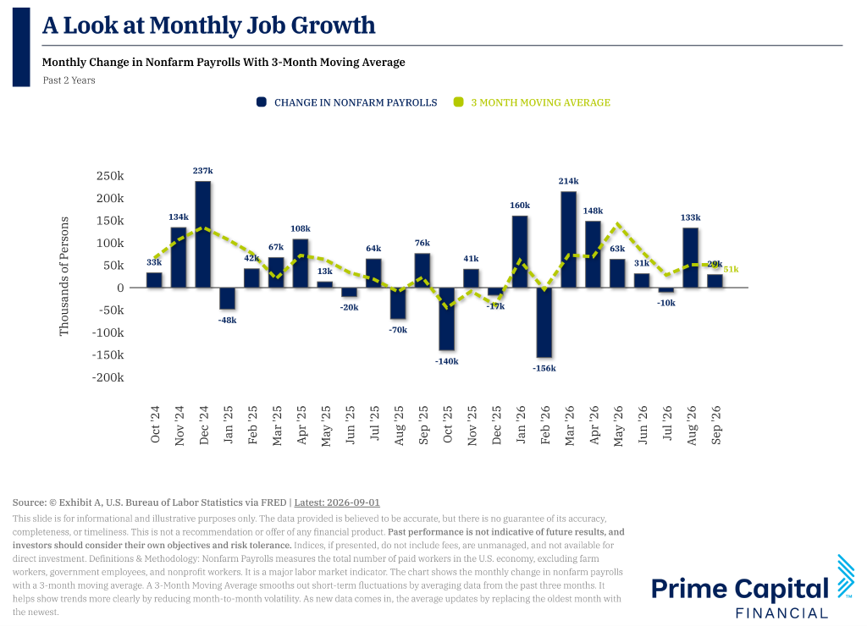
29,000 jobs. September’s jobs report, bundled with an increase in unemployment, cooling wage growth and revised payroll gains for July and August, made Wall Street sit up a little straighter.
But the message was mixed. In spite of all indications that the labor market was losing steam, the markets still rallied. If you only look at the headline number—29,000 jobs added—it can feel a little bleak. But the bigger picture is more nuanced, and that nuance matters for your portfolio.
Prime Capital Financial’s chief investment officer, Will McGough, and portfolio manager, Clayton Allison, examine what the latest labor data says about the U.S. economy, what it could mean for the Federal Reserve’s ongoing inflation analysis, and where investors may want to pay attention next.
September Jobs Report: Why the Headline Number Is Only Part of the Story
A gain of 29,000 jobs is far below what most economists would consider strong growth. On the surface, that can look like a warning sign. But, as McGough points out, context matters in any market analysis.
A monthly gain of roughly 50,000 to 100,000 jobs is often considered a break-even range for a growing economy. Strong, healthy expansion usually shows up in gains closer to 150,000 to 200,000 or more. When you zoom out, the past three months have averaged about 51,000 new jobs per month, putting the labor market near that break-even zone rather than in outright decline.
That distinction matters. A slowing labor market is not the same thing as a collapsing one. In fact, one of the most important details in the report is what didn’t happen: layoffs remain historically low.
McGough describes the current environment as a “slow to hire, slow to fire” economy. Companies may be adding fewer workers, but they are also not rushing into large-scale layoffs. That often points to a labor market that is cooling without cracking.
Another important factor is productivity. Businesses have been able to support earnings with fewer workers, which may be partly tied to technology and AI-driven efficiency. That helps explain why the market did not panic on a softer jobs report. Rather than recession signals, investors are seeing an economy that is normalizing.
What the Fed Is Watching & Why One Report Won’t Change Everything
The next big question is whether this jobs report changes the Federal Reserve’s thinking. Allison’s answer is essentially no, not by itself.
The Fed has a dual mandate: price stability and full employment. Right now, inflation remains the bigger concern. That means the central bank is unlikely to react aggressively to one soft jobs report unless the trend becomes more obvious.
That matters because markets often want a single data point to settle the debate. They want to know whether the Fed is done hiking, ready to cut, or still willing to raise rates again. But the Fed rarely makes major policy decisions based on one month of labor data.
Allison notes that traders may have hoped the report would shift the Fed’s stance immediately, which helped fuel the market rally. But the underlying policy reality is more cautious. Higher interest rates can slow the economy and weaken hiring, so the Fed has to be careful not to push too far and trigger a bigger rise in unemployment.
This is the balancing act:
- If the Fed stays too tight for too long, it risks damaging the labor market.
- If it eases too early, inflation could remain stubborn.
- If it reacts too quickly to one data point, it may overcorrect.
That is why the market response matters. Investors saw cooler job growth and slower wage gains as signs that the Fed may have more room to pause. But it’s important to note that a pause is not the same as a pivot.
Wages, Inflation, and the Consumer Squeeze
Slower hiring is one thing. Slower wage growth is another. And it may be even more important for investors.
In September, wages rose just 0.1% for the month and about 3% over the past year. That sounds decent until you compare it with inflation, which has recently run a bit hotter. When inflation outpaces wages, purchasing power gets squeezed.
That is where the consumer story becomes more interesting.
McGough points out that, according to survey data, consumer sentiment is in the dumps. People say they feel bad about the economy. But actual consumer spending is still growing at around 3%, suggesting households are still spending even if they are unhappy about it. That gap between how people feel and what they do is one of the most important things investors can watch.
Why? Because spending drives earnings, and earnings drive markets.
If wages slow further while inflation stays sticky, the consumer could become more cautious. That would eventually show up in corporate revenues and profit margins. On the other hand, if inflation continues to cool while wages hold near 3%, real income growth improves, even if only modestly.
That is a key nuance: explosive wage growth is less important to supporting the economy. You need wages to keep up enough with prices so households can maintain spending.
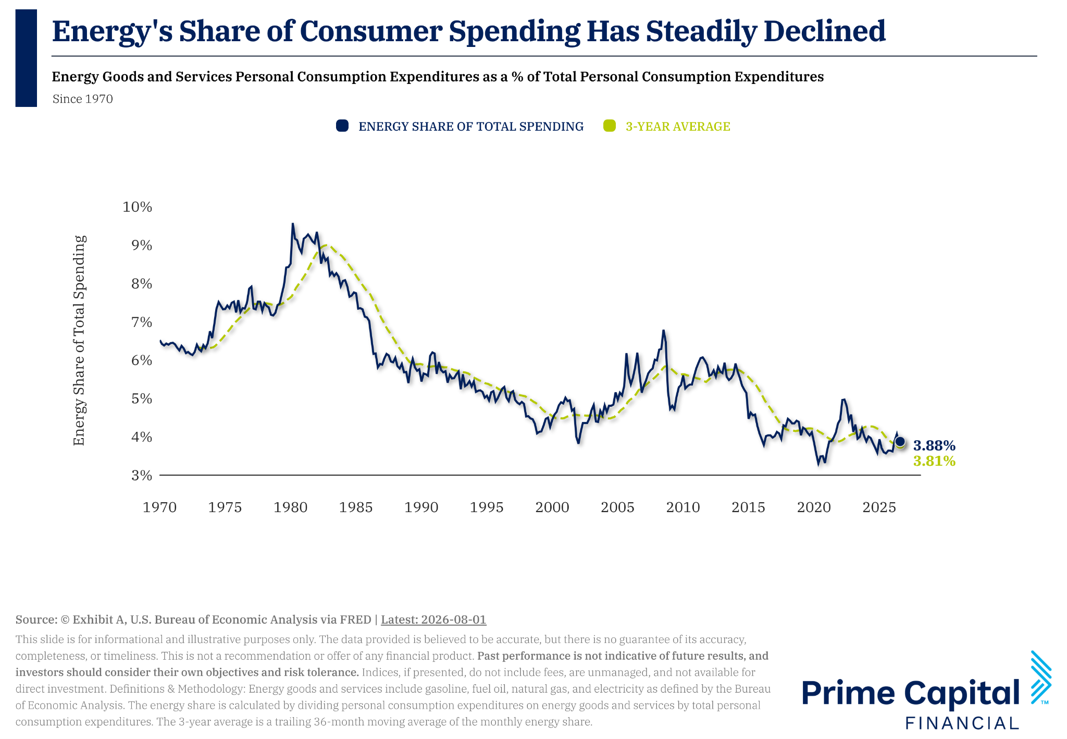
McGough also points to oil prices as a major variable. If oil falls or at least stops rising sharply, that can relieve pressure on consumers. Historically, consumer stocks have often performed better after oil spikes fade. That makes energy prices one of the most practical things to watch when thinking about the next leg of consumer spending.
Where Investors May Want to Focus in a Slower-Growth Environment
Once you move from macro data to portfolio construction, the conversation becomes more actionable. Allison says a more patient Fed and a slower-growth backdrop tend to favor companies and assets that do not depend heavily on cheap borrowing.
That means investors may want to pay attention to businesses with:
- Strong free cash flow
- High earnings yield
- Cash-funded growth
- Lower debt dependence
- Defensive characteristics
Why does that matter? In a higher-rate environment, companies that rely on debt to fund expansion can feel more pressure. Borrowing costs stay elevated, and that can make growth harder to finance. By contrast, companies with solid balance sheets and real cash generation tend to hold up better when markets get choppier.
Healthcare is one example Allison highlights because it often fits the defensive growth profile. It can offer growth characteristics without being as sensitive to financing costs as more leveraged parts of the market.
Fixed income also deserves attention. That may surprise investors who have been focused mainly on equities, but the bond market has become more compelling as Treasury yields have climbed to levels not seen in more than 20 years. Higher yields can offer income potential, especially for retirees and income-oriented investors.
There is another benefit, too: if you buy quality bonds at a discount, you may be able to capture both income and price appreciation over time. That makes fixed income a more attractive option than it was when yields were far lower.
The key here is not to think in absolutes. This is not about abandoning stocks and piling into bonds. This is a moment to recognize which parts of the market tend to work better when growth slows and the Fed remains cautious.
What Investors Should Actually Do Next
The biggest lesson from the September jobs report is that the labor market is cooling in a way that gives the Fed more flexibility, while still leaving room for uncertainty.
That matters because markets hate guessing games. Investors tend to feel steadier when they have a framework that can handle shifting conditions rather than trying to predict every monthly payroll report or inflation print.
Here is the practical checklist:
- Don’t overreact to one report.
A single weak month does not define the economy. - Watch the trend, not just the headline.
Wage growth, layoffs, consumer spending, and inflation all matter. - Pay attention to balance sheets.
Companies with cash flow and less debt often fare better in slower-growth environments. - Don’t ignore fixed income.
Higher yields can create better opportunities than investors have seen in years. - Keep your financial plan flexible.
The goal is to be prepared with a plan that is built for a variety of outcomes.
September’s report did not answer every question, but it did reinforce a bigger truth: markets can absorb softer data when the economy is still holding together.
Final Thought
September’s jobs report showed a labor market that is softer, but not broken. Job gains slowed, unemployment ticked higher, and wage growth cooled, yet layoffs stayed low and consumer spending remained resilient. That combination helps explain why markets could take the news in stride.
For investors, the message is simple: day-to-day headlines are messy, so stay focused on the trend. In a slower-growth environment, quality balance sheets, defensive growth, and fixed income may deserve a closer look. More importantly, a well-built financial plan matters more than trying to predict every single data release.
Want to go deeper? Watch the full conversation with Will, Clayton, and Terra here:
Frequently Asked Questions
Is a weak jobs report always bad for stocks?
Not necessarily. Sometimes a softer jobs report can boost stocks if investors believe it reduces the odds of more Fed rate hikes. The key is whether the data signals a manageable slowdown or a more serious recession risk.
Why did the market rally after the September jobs report?
Markets rallied because the report lowered expectations for another immediate interest rate hike. Slower job growth and cooling wages can make the Fed more patient, which investors often view as supportive for asset prices.
What does “slow to hire, slow to fire” mean?
It means companies are hiring less aggressively, but they are also not doing mass layoffs. That usually signals a labor market that is cooling without breaking down.
Which investments tend to do better when economic growth slows?
Defensive growth areas like healthcare and high-quality fixed income can become more attractive. Investors often also look for companies with strong cash flow and less debt.
Why does wage growth matter so much?
Wages help determine whether consumers can keep spending as prices rise. If wages fall behind inflation for too long, purchasing power weakens, which can affect corporate earnings.
Let’s Chat!
If you have questions about this topic, or any others, and would like to speak to a financial advisor, fill out the form below and a member from our team will reach out to you shortly.
Advisory products and services offered by Investment Adviser Representatives through Prime Capital Investment Advisors, LLC (“PCIA”), a federally registered investment adviser. Tax planning and preparation services are offered through Prime Capital Tax Advisory. PCIA: 6201 College Blvd., Suite 150, Overland Park, KS 66211. PCIA doing business as Prime Capital Financial | Wealth | Retirement | Wellness | Family Office | Tax Advisory.